
Commercial Landscape Ideas for Business Properties
Commercial landscaping is the design, installation, and upkeep of the grounds around a business property: entrances, parking areas, walkways, gathering spaces, and planting. It differs from residential work less in the plants than in the constraints. Everything has to handle traffic, survive salt and snow removal, stay clear of sightlines, satisfy municipal requirements, and look composed on a schedule rather than on a good day.
Most commercial properties settle for turf and a few shrubs. That is a missed opportunity, because the grounds are the part of a property every visitor experiences and one of the few parts that can be meaningfully improved without touching the building.
What follows are ideas that hold up on Chicagoland commercial sites, and the practical considerations behind each. Apex Landscaping has designed and built commercial landscapes here since 1991.
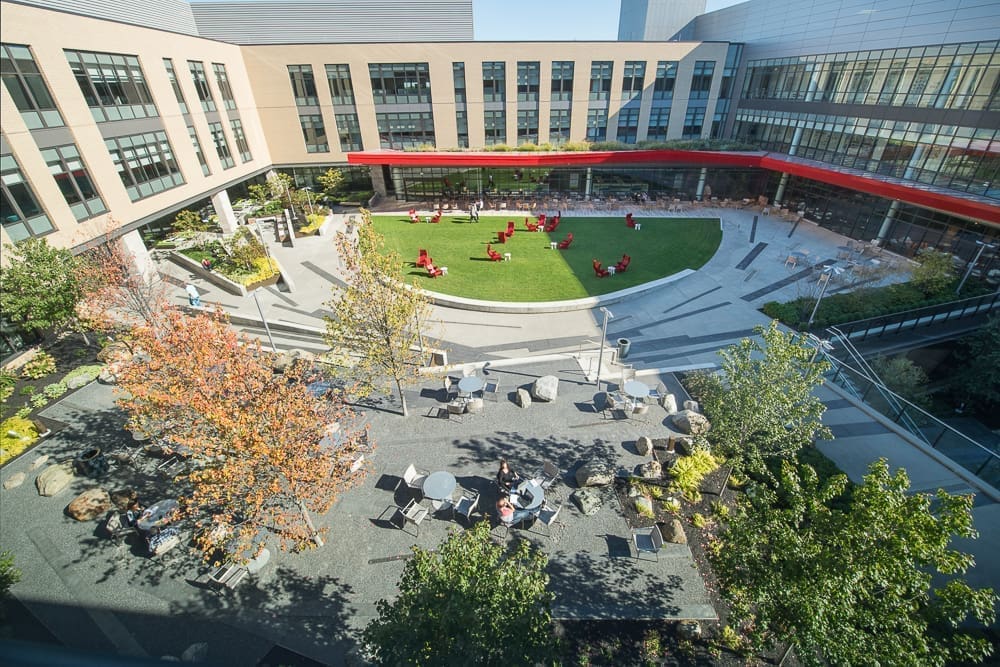
The arrival sequence
The first fifty feet of a property does more work than the rest of the site combined. It is where a visitor forms an impression and where wayfinding either functions or does not.
Entrance plaza and signage planting. A defined arrival area with planting that frames rather than obscures the sign. The most common error is planting that looks correct at installation and blocks the sign in three years. Mature size, not nursery size, is what to design to.
Wayfinding. Planting and paving used to indicate where to drive, where to park, and where to walk. This works better than additional signage, and it looks less institutional.
Parking-lot islands. Frequently an afterthought, and one of the highest-leverage areas on a commercial site. Islands take reflected heat, road salt, and compacted soil, so species selection matters more here than anywhere else on the property. Well-planted islands also break up an expanse of asphalt visually.
Pedestrian routes. Walking paths that follow how people actually cross the site. Where a desire line exists, pave it, because otherwise it becomes a worn track through the lawn.
Outdoor space people actually use
Outdoor amenity space has become an expectation on office and mixed-use properties rather than a differentiator.
Seating that suits real use. A mix of individual and group seating, some in sun and some in shade, positioned away from service routes and building exhaust.
Shade. Whether from structures or from trees, shade determines whether a space is used between May and September. Trees take time, so on a new build the structure carries the first several years.
Work-capable space. Where a property wants outdoor space used during the working day, that means shade, some wind protection, and seating at a workable height.
Gathering areas. Space that can hold a group for an event without being permanently oversized.
Circulation. Keeping the routes people take to and from the building clear of seated areas, so the space is comfortable to sit in.

Water: irrigation and stormwater
On commercial sites water is two separate problems that need one coordinated answer.
Irrigation efficiency. Zoning by plant need and by exposure rather than by convenience, so turf and beds are not on the same schedule. Controllers that adjust to weather and soil conditions reduce both water use and the plant stress that comes from a fixed schedule. Getting the zone plan right at design time is what makes the system work; the controller is the smaller part.
Stormwater. Commercial sites carry large impervious areas, and municipalities across Chicagoland regulate how much runoff a property may discharge and where. Detention areas, bioswales, rain gardens, and permeable paving all appear on commercial sites for this reason, and they can be designed as landscape rather than as visible infrastructure.
Detention basins. Often the largest single landscape area on a commercial property and usually the most neglected. A basin planted appropriately handles its hydrologic job and stops reading as a ditch.
Drainage around hardscape. Water shed off paving has to go somewhere deliberate. This is covered in depth in the importance of proper drainage in landscaping.
Requirements vary by municipality, so they get checked against the specific village during design.
Water features
A water feature earns its place on a commercial property when it does more than look expensive.
Moving water masks traffic and mechanical noise, which is its most practical benefit on a site near a road. It also creates a natural focal point for an arrival area or a courtyard.
The considerations are operational: winterization in our climate, ongoing water treatment and cleaning, pump maintenance, and safety and access on a public site. Pondless designs deliver the sound and movement with less standing water and a smaller maintenance and safety footprint, which is often the right answer commercially.

Lighting
Commercial lighting is a safety system first and a design element second, and the good versions do both.
Circulation and safety. Even coverage on walks, steps, and parking routes, aimed to avoid the pools of glare and deep shadow that blanket floodlighting produces.
Building and entrance. Light that defines the entrance and reads clearly after dark.
Landscape accent. Uplighting on specimen trees and grazing light on walls, which is what keeps a property from ending abruptly at the edge of the parking lot.
Zoning and control. Separating safety lighting, which runs on a schedule, from accent lighting, which does not, so the property is not fully lit at three in the morning.
Design principles carry over from residential work; see backyard lighting ideas for the layering approach.
Seasonal structure and display
Chicagoland asks a landscape to look composed across a wide range of conditions.
Evergreen structure. The bones that carry a property through winter, when deciduous planting is bare. On a commercial site this matters disproportionately, because the property is occupied year-round.
Seasonal rotation. Annual displays at entrances and key nodes, changed on a schedule. Concentrating them where they are seen rather than spreading them thin is what makes a modest program look intentional.
Four-season interest. Species chosen for bark, berry, seed head, and winter form, not only for bloom.
The USDA Plant Hardiness Zone Map places Chicagoland in zones 5b to 6a. The Morton Arboretum in Lisle, the Chicago Botanic Garden, and University of Illinois Extension all publish regional guidance on species that perform in these conditions, including under the salt and compaction loads a commercial site imposes.

Hardscape that survives a Chicagoland winter
Commercial hardscape takes a beating that residential hardscape does not: heavier traffic, plow blades, and repeated salt.
Base and drainage. As with any paving here, what sits underneath decides whether the surface is level in ten years. Water trapped in an inadequately drained base expands when it freezes and lifts the surface.
Salt tolerance. De-icing materials damage some paving and masonry and kill adjacent planting. Material selection and planting choice next to walks and drives should assume salt exposure.
Plow clearance. Bollards, raised islands, and edge details need to survive a plow blade, and snow needs somewhere to be stacked that will not kill the planting it lands on. This is worth coordinating with whoever handles commercial snow plowing at design time rather than discovering it in January.
Accessibility. Slopes, cross-slopes, transitions, and detectable warnings are regulated. Getting this right at design is far cheaper than correcting it.
Material comparisons are covered in outdoor hardscape ideas.
Landscape that reflects the brand
Done with restraint, a landscape can carry brand identity without turning into signage.
Color is the usual route, through seasonal display keyed to brand palette. It works when it is a note rather than the theme; a property planted entirely in one corporate color reads as a theme park.
Form and material matter more and are used less. A precise, geometric planting scheme and a loose naturalistic one say very different things about an organization, and either can be right.
The constraint worth stating plainly: the landscape still has to work horticulturally. A species chosen only because it matches a brand color, and which will not thrive in a parking island, is a replacement cost on a schedule.
Frequently asked questions
What is commercial landscaping?
The design, installation, and maintenance of grounds around business properties: entrances, parking areas, walkways, outdoor gathering space, and planting, along with irrigation, stormwater features, and often snow and ice management.
How is it different from residential landscaping?
Scale, durability, and regulation. Commercial sites carry more traffic, more salt, and municipal requirements around stormwater, accessibility, and sometimes landscape ordinances. Work is also scheduled around occupancy.
What should a commercial property prioritize first?
Usually the arrival sequence, because it carries the most visibility per unit of investment, and drainage, because unresolved water problems damage everything built on top of them.
How long does a commercial landscape project take?
It depends on scope, permitting, and season. Design and municipal review often take longer than installation. Projects designed over winter are the ones that get built early in the season.
Do commercial landscape projects need permits?
Frequently. Work affecting stormwater, grading, impervious surface, accessibility, or right-of-way planting can require municipal review, and requirements vary by village.
Can a landscape be upgraded without a full redesign?
Usually yes. Entrances, islands, and seasonal display can be improved individually, and a phased plan lets a property spread work across budget cycles while still following one design.
Working with Apex Landscaping
Apex Landscaping has designed, built, and maintained commercial landscapes across Chicagoland’s north and northwest suburbs and the North Shore since 1991. We are a design and build team, so the people who draw the plan are accountable for what gets installed. We are licensed and insured, and our team includes ISA-Certified Arborists, which matters on properties with mature canopy or significant tree assets.
We maintain grounds at more than 90 commercial and association properties across Chicagoland.
See our commercial landscaping services for the full scope, commercial landscape maintenance for ongoing programs, completed work in our landscape gallery, or start a conversation about your property.