
Does Landscaping Increase a Home’s Value?
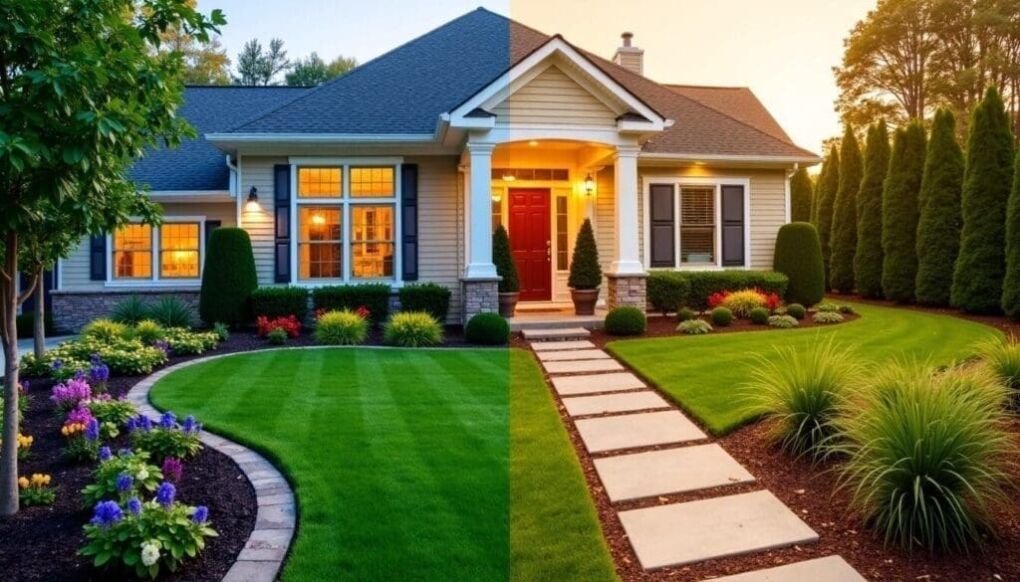
Yes, and the size of the effect depends far more on quality and fit than on spend. A well-designed landscape suited to the house and the site adds value. An expensive one that fights the architecture, outgrows the lot, or ignores drainage can subtract it.
You will find a lot of confident percentages on this question. Most come from national surveys of different housing markets and different climates, and none of them describes your street. What follows is what actually drives the outcome, framed for Chicagoland, where clay soil and freeze-thaw decide more than most people expect.
Apex Landscaping has designed and built across the north and northwest suburbs and the North Shore since 1991.
What actually drives the value
Design coherence. Whether the landscape looks like it belongs to the house. A design that matches the architecture’s period and scale reads as intentional; one that does not reads as expense without judgment.
Maturity. Established planting is the one thing a buyer cannot get quickly at any price. A landscape that has filled in is worth disproportionately more than the same design newly installed, which is an argument for planting sooner rather than for spending more.
Usable outdoor space. A patio or outdoor room that functions as somewhere people would actually sit reads as additional living space. An unshaded slab in an awkward spot does not.
Function that works. Drainage that moves water away from the house, paths that go where people walk, lighting that makes the entry usable after dark. These rarely get admired and they are always noticed when absent.
Condition. A well-kept landscape signals a well-kept property. A neglected one raises the question of what else was neglected, which is the most expensive impression a house can make.
Privacy and enclosure. Screening that creates a sense of separation without walling the property in.
What does not reliably drive value: highly personal features, anything that reads as high-maintenance, and features that suit a different climate.
See our landscape design page for how these decisions get made.
The projects that carry the most weight
The front entry sequence. The drive, the walk, and the door. It is the first thing seen and the cheapest to improve relative to its effect. Covered in front yard landscaping ideas.
A patio or outdoor living space. The clearest “extra room” argument in a landscape. See outdoor living spaces with patio pavers.
Trees. Mature canopy is genuinely irreplaceable, and protecting existing trees usually matters more than planting new ones. Our team includes ISA-Certified Arborists, which is relevant on wooded lots where construction threatens root zones.
Drainage correction. Rarely exciting, and the one item that a buyer’s inspection can turn into a price negotiation. See the importance of proper drainage in landscaping.
Lighting. Extends usable hours and improves the arrival impression. See backyard lighting ideas.
Structural repair. A failing retaining wall or a settled patio is a visible liability. Fixing it protects value rather than adding it, which is still worth doing first.
Designing for how the family actually uses the yard
A yard designed around actual use is worth more than one designed around a photograph, and the considerations below are the ones most often missed.
Sightlines and supervision. Where children play should be visible from where adults sit and from the kitchen window. This single decision determines whether a family uses the space.
Impact-absorbing surfaces. Under play equipment, the surface matters more than the equipment. Engineered wood fiber, rubber, or deep mulch over adequate depth, with the fall zone sized to the equipment.
Non-toxic planting. Several common ornamentals are toxic if ingested. On a property with young children or dogs, the palette should be checked rather than assumed. University of Illinois Extension publishes guidance on plant selection for Illinois conditions.
Water features, designed for safety. Depth, edge treatment, and access all decide whether a feature is appropriate. Pondless designs deliver movement and sound without standing water.
Fencing and access. Secure boundaries, gates that self-close where they need to, and a clear route out in an emergency.
Room to change. The best family landscapes anticipate that a sandbox becomes a seating area. Designing zones that can be repurposed avoids rebuilding in eight years.
Covered, partly covered, or open?
Roofing over outdoor space is one of the larger decisions and it changes both use and cost.
Open is the most flexible and the cheapest, and it is unusable in rain and midday summer sun.
Partly covered, with a pergola or a partial roof over one zone, is usually the best value: shelter where you sit, open sky over the rest.
Fully covered makes a space usable in weather and reads as a genuine room. It is a structural project, usually with footings and often with permits, and it changes the light reaching the house behind it.
Deck versus patio is the related question. A patio at grade connects better to the yard and lasts longer with less upkeep. A deck makes sense where grade drops away from the house.
What this costs, honestly
No figures, because the honest answer is that they would be wrong for your property. What actually moves the number:
- Scope and scale, and how many separate elements are involved
- Site access, which is the factor homeowners most underestimate. Whether machinery reaches the work area changes the labor substantially
- Grading and drainage, the work that happens before anything visible
- Material selection
- Structural elements, walls and steps, and anything needing engineering
- Permits and municipal review, which vary by village
- Existing conditions, including demolition and protecting mature trees
Two useful principles. Phasing works. A master plan built in stages across several years spreads cost without the result looking piecemeal. And the invisible parts are the wrong place to save. Base depth, drainage, and soil preparation are cheap to do properly once and expensive to correct.
How to judge whether a quote is fair is covered in how to tell if your landscaping company is giving you a fair price.
Chicagoland specifics
Hardiness. The USDA Plant Hardiness Zone Map places Chicagoland in zones 5b to 6a. Anything specified has to be reliably hardy through our winters, and a plant that is marginal here will look fine for three years and then not.
Clay soil. Much of the region sits on dense glacial clay that holds water and drains slowly. It shapes plant selection, bed preparation, and every drainage decision on the site.
Freeze and thaw. Water held in the wrong place expands when it freezes, which is what heaves patios, cracks surfaces, and pushes retaining walls out of line. Base depth and drainage are what prevent it.
Salt. Along drives and walks, de-icing material kills planting that is not tolerant of it. Species selection near hard surfaces should assume exposure.
A defined season. Design has to account for what the property looks like in February, not only in June. Evergreen structure, bark, and seed heads are what carry a landscape through a Chicagoland winter.
The Morton Arboretum in Lisle, the Chicago Botanic Garden, and University of Illinois Extension all publish regional guidance worth consulting on species selection for these conditions.
Mistakes that cost value
Over-personalization. Features that suit one owner specifically narrow the buyer pool.
Hardscape and greenery out of balance. Too much paving reads as a parking area and creates drainage problems. Too little leaves nowhere to be.
Planting for today’s size. The most common and most expensive error. Shrubs spaced for the pot they arrived in become a hedge against the windows in six years.
Ignoring drainage. Everything built on top of an unresolved water problem inherits it.
High-maintenance choices. A landscape that demands constant attention is a liability to a buyer who does not want that commitment.
Fighting the architecture. A formal scheme on an informal house, or the reverse, reads as a mismatch even to people who cannot say why.
Neglect. The fastest way to lose landscape value is to stop looking after what is already there.
Frequently asked questions
Does landscaping increase a home’s value?
Yes, when it is well designed, suited to the house, and in good condition. The effect comes from design quality, maturity, usable space, and function rather than from spend.
What landscaping adds the most value?
Generally the front entry sequence, usable outdoor living space, mature trees, and drainage that works. Repairing something visibly failing usually comes before adding something new.
Should I landscape before selling?
Cleaning up, correcting drainage, and improving the entry are usually worth doing. Large installations shortly before listing rarely return their cost, because a new landscape has not matured and buyers can see that.
How long before a new landscape looks established?
Depends on plant size at installation and species. Most planting reads as established in a few seasons; trees take considerably longer, which is the argument for planting early rather than for buying large.
Is professional design worth it on a modest project?
For a planting refresh, often not. Where grading, drainage, hardscape, or structure is involved, professional input usually costs less than correcting the result.
Can landscaping reduce a home’s value?
Yes. Over-personalized features, planting that has outgrown the site, unresolved drainage, and visible neglect all work against a sale.
Working with Apex Landscaping
Apex Landscaping has designed and built landscapes across Chicagoland’s north and northwest suburbs and the North Shore since 1991. We design and build as one team, so the plan is made by the people accountable for installing it. We are licensed and insured, and our team includes ISA-Certified Arborists.
We have worked across Chicagoland since 1991, including for 60 municipalities in the region.
See landscape design and build, view completed projects in our landscape gallery, read about the company on our about page, or start a conversation about your property.
If you are planning for next season, winter is when the design work happens. Projects drawn over the winter are the ones built early in spring.